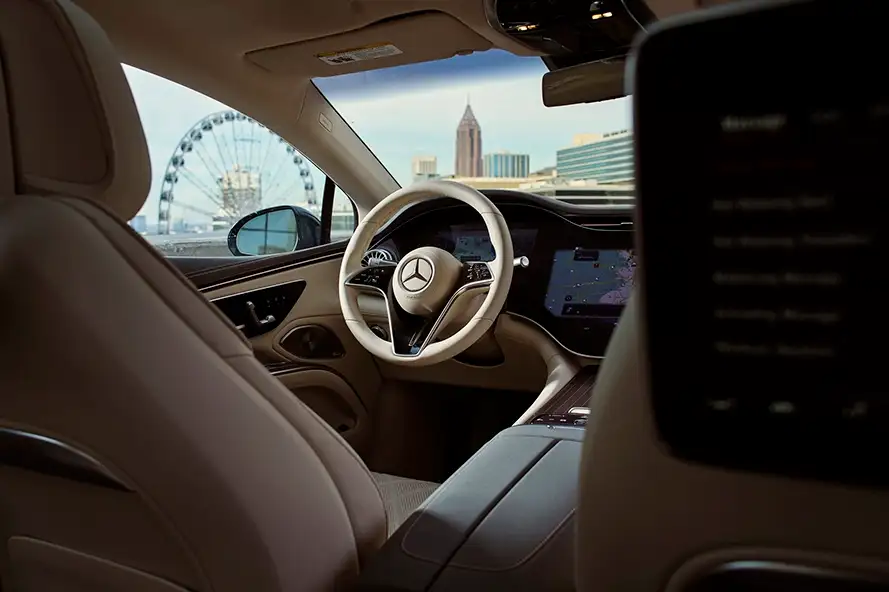
Section 179 of the IRS tax code allows qualifying businesses to deduct eligible vehicle and equipment acquisition costs from their taxable income. For the 2026 tax year, select Mercedes-Benz SUVs and commercial vehicles may qualify for significant business vehicle tax benefits, subject to applicable IRS requirements and deduction limitations.
For business owners in Orange County, Section 179 presents an opportunity to invest in the luxury, performance, and innovation of a Mercedes-Benz while exploring potential federal tax advantages. At Mercedes-Benz of Foothill Ranch, we offer a selection of premium vehicles that may satisfy applicable Section 179 weight and business-use requirements.
Explore our qualifying Section 179 Mercedes-Benz inventory to discover available vehicles for your business.
Section 179 allows eligible businesses to deduct qualifying vehicle costs in the tax year the vehicle is placed in service. To claim a vehicle-related Section 179 deduction, the vehicle generally must be acquired for business purposes, placed in service during the applicable tax year, and operated more than 50% of the time for qualifying business use.
For vehicles placed in service during 2026, eligible businesses may also benefit from 100% bonus depreciation on qualifying remaining vehicle basis after applying Section 179. Bonus depreciation eligibility depends on acquisition dates, vehicle classification, business use, and other IRS requirements.
Business owners should work with a qualified tax advisor to evaluate vehicle eligibility, allowable deductions, and the potential impact on their individual tax situation.

Purchase before year’s end and your business may qualify to deduct up to $32,000 through Section 179 and/or up to 100% of the purchase price through Section 168(k)**
*$6,720 tax savings based on 21% federal corporate tax rate and eligibility to claim full $32,000 IRS Section 179 tax deduction for qualified vehicles. Your tax rate and eligibility may vary. Please consult a tax professional for more information on your federal tax rate and potential savings available to you for qualifying purchases. This information does not constitute, nor is it intended to be, legal, tax, financial planning or investment advice and should not be relied upon as such. $32,000 tax deduction for qualifying vehicles based on current Section 179 of U.S. tax code and maximum deduction permitted for such vehicles under Section 179. Vehicle must be purchased for business use. Please consult your tax advisor.
**Tax incentives, including Section 179 and Section 168(k), may be available for qualifying vehicles. Taxpayers may be entitled to U.S. federal income tax deductions and/or credits for purchases of vehicles that are placed in service in a trade or business during 2026. Determining the proper income tax treatment of any vehicle purchase requires careful consideration of several factors including, but not limited to, the applicable laws, regulations, and guidelines, the characteristics and attributes of the particular vehicle purchased and the purchaser’s income tax situation. Each purchaser’s tax situation is unique and the available tax benefits and the applicable federal tax laws, regulations and guidelines are subject to change without notice. Therefore, customers must consult their tax advisor to determine the proper tax treatment of any vehicle purchase(s). For more information, visit www.irs.gov. This information does not constitute, nor is it intended to be, legal, tax, financial planning or investment advice and should not be relied upon as such.
The IRS has established the following federal Section 179 limits for tax years beginning in 2026:
The maximum Section 179 deduction is also subject to taxable business income limitations. Vehicle-specific rules, business-use percentages, and additional depreciation restrictions may affect the final allowable deduction.
For official tax guidance, visit the IRS Publication 946: How to Depreciate Property.
2026 Section 179 Deduction Limit: $32,000
Select Mercedes-Benz SUVs, including qualifying configurations of the Mercedes-Benz GLE, GLS, G-Class, EQE SUV, and EQS SUV, may satisfy the weight requirements for the heavy SUV category.
Eligible heavy SUVs may qualify for a Section 179 deduction of up to $32,000, followed by applicable bonus depreciation on the remaining eligible cost basis. When all relevant requirements are satisfied, combined first-year depreciation deductions may potentially cover the full eligible business-use portion of a qualifying vehicle’s cost.
The exact vehicle configuration, manufacturer’s GVWR, business-use percentage, and applicable tax rules determine eligibility. The $32,000 heavy SUV limit applies to the Section 179 portion of the deduction and does not necessarily represent the maximum combined first-year depreciation deduction.
2026 Section 179 Deduction: Potentially Up to $2,560,000 in aggregate qualifying property, subject to limitations.
Certain qualifying commercial vehicles, including eligible Mercedes-Benz Sprinter Cargo Van configurations, may be exempt from the special heavy SUV Section 179 limitation when they satisfy applicable vehicle design and classification requirements.
These vehicles may qualify for additional deductions based on their eligible business-use cost, provided all IRS requirements are satisfied. The overall Section 179 maximum, taxable income limitation, and applicable phase-out rules still apply.
Passenger vehicles within the applicable IRS depreciation limitation category are subject to special annual depreciation caps.
These amounts represent combined applicable annual depreciation limitations rather than separate deductions that can automatically be added together. The actual allowable amount may be lower depending on vehicle cost, business use, and tax circumstances.
Gross Vehicle Weight Rating (GVWR) represents the manufacturer’s maximum permitted operating weight of a vehicle, including the vehicle, passengers, cargo, and other allowable loads. GVWR is different from curb weight and is an important consideration when evaluating Section 179 vehicle eligibility.
You can typically find your Mercedes-Benz vehicle’s GVWR through the following sources:
Because GVWR can vary between Mercedes-Benz models, powertrains, and configurations, confirm the weight rating of the individual vehicle before making a tax-related acquisition decision.
Mercedes-Benz offers a range of luxury SUVs that may satisfy the GVWR requirements associated with Section 179 heavy SUV deductions. Depending on their individual specifications, qualifying configurations may include:
For the 2026 tax year, eligible heavy SUVs may qualify for up to $32,000 in Section 179 deductions, with potential additional bonus depreciation on the remaining qualifying business-use basis.
Not every trim level or model configuration necessarily satisfies the applicable weight threshold. Actual eligibility must be confirmed using the specific vehicle’s manufacturer’s GVWR and relevant tax requirements.
Explore our Mercedes-Benz SUV inventory to discover available models and configurations at Mercedes-Benz of Foothill Ranch.
Certain qualifying Mercedes-Benz SUVs may be eligible for combined first-year depreciation deductions totaling up to 100% of their eligible business-use cost under current federal tax rules.
Although the Section 179 deduction for qualifying heavy SUVs is limited to $32,000 in 2026, eligible businesses may also claim bonus depreciation on the remaining qualifying basis after the Section 179 deduction.
For example, a qualifying SUV acquired for $90,000 and operated exclusively for eligible business purposes could potentially receive a $32,000 Section 179 deduction and an additional $58,000 bonus depreciation deduction, assuming all applicable conditions are satisfied.
This illustration is hypothetical and does not represent a guaranteed tax deduction or a specific vehicle offer. A tax professional should evaluate the taxpayer’s business income, vehicle acquisition, business use, depreciation eligibility, and applicable federal and state requirements.
Business owners operating through a Limited Liability Company (LLC) may be eligible to claim Section 179 deductions on qualifying Mercedes-Benz vehicles. Tax treatment depends on how the LLC is classified for federal tax purposes, vehicle ownership, business use, and other applicable requirements.
A conventional vehicle lease generally follows different tax deduction rules from an eligible purchase or financed acquisition. Business owners should review the applicable treatment with a qualified tax advisor before selecting a financing or leasing arrangement.
For tax years beginning in 2026, the Section 179 deduction limit for qualifying heavy SUVs is $32,000. Eligible vehicles may also qualify for additional bonus depreciation, subject to applicable IRS rules and business-use requirements.
Certain configurations of the Mercedes-Benz GLE, GLS, G-Class, EQE SUV, and EQS SUV may have a manufacturer-rated GVWR exceeding 6,000 pounds. Confirm the specific vehicle’s GVWR because weight ratings can vary by model year, trim, and configuration.
No. A qualifying vehicle generally must be operated more than 50% for eligible business purposes to claim Section 179. The deductible amount is based in part on the documented business-use percentage. If business use later falls to 50% or less during the applicable recovery period, depreciation recapture rules may apply.
Yes. A qualifying Mercedes-Benz purchased through eligible financing may satisfy Section 179 acquisition requirements even when financing payments extend beyond the tax year. The vehicle must be placed in service and meet all applicable business-use and IRS requirements.
Certain all-electric Mercedes-Benz SUVs, including qualifying EQE SUV and EQS SUV configurations, may satisfy the weight requirements for Section 179. Eligibility depends on the specific vehicle’s GVWR, tax classification, business use, and applicable federal tax rules.
Yes. Qualifying pre-owned Mercedes-Benz vehicles may be eligible for Section 179 deductions if they satisfy applicable acquisition, business-use, and property requirements. Eligibility for bonus depreciation is subject to additional acquisition rules.
California state tax rules differ from federal Section 179 and bonus depreciation provisions. Business owners in California should consult a qualified tax professional to determine the applicable state and federal treatment of a qualifying Mercedes-Benz vehicle.
Mercedes-Benz of Foothill Ranch offers a selection of premium SUVs for business owners throughout Orange County. Conveniently located near Irvine and Lake Forest, our dealership can assist you in exploring available models and reviewing manufacturer vehicle specifications.
At Mercedes-Benz of Foothill Ranch, we are proud to help Southern California business owners discover luxury SUVs that may satisfy Section 179 vehicle weight requirements. Whether you are considering a Mercedes-Benz GLE, GLS, G-Class, or an all-electric SUV, our sales professionals can help you compare available configurations and explore vehicles suited to your professional lifestyle.
Located at 81 Auto Center Dr., Foothill Ranch, CA 92610, we proudly serve drivers and business owners throughout Foothill Ranch, Irvine, Lake Forest, Trabuco Canyon, Mission Viejo, and Rancho Santa Margarita.
Browse our new Mercedes-Benz vehicles, explore our pre-owned inventory, or view Certified Pre-Owned Mercedes-Benz vehicles to find a luxury SUV that meets your business needs.
To learn more about available Mercedes-Benz SUVs, contact Mercedes-Benz of Foothill Ranch or call our Sales Team at (949) 328-8800.
The information on this page is intended for general educational purposes only and does not constitute tax, legal, accounting, or financial advice. Section 179 deduction limits and bonus depreciation rules are subject to IRS requirements, taxpayer eligibility, business income limitations, vehicle classifications, acquisition dates, placed-in-service dates, and qualifying business use. Individual results may vary. California state income tax treatment may differ from federal tax treatment. Mercedes-Benz of Foothill Ranch does not determine tax eligibility or provide tax advice. Consult a qualified tax professional regarding your individual circumstances before making a vehicle acquisition or tax filing decision. Vehicle specifications and availability are subject to change.